
Telehealth Platform for Patient Consultations
PharmD Live is a patient-centric and outcome-driven healthcare technology company. Our mission is to enhance patients’ quality of life and improve clinical and financial outcomes for physicians, hospitals, and care facilities. Our solutions leverage innovative technology and the expertise of clinical pharmacists to optimize medication therapy and mitigate risks across the continuum of care.
UI Product Design | 2019 - 2020
Desktop, Mobile Prototyping
Sketch, Photoshop, Dreamweaver, Invision, Slack, Confluence, Trello
Problem
Patients often struggle to understand medication plans, chronic condition management, and pharmacist recommendations. PharmD Live aimed to bridge this gap by offering a virtual consultation platform, but the early product lacked:
An intuitive flow for scheduling and joining consultations
Clear UI for sensitive medical information
Easy-to-follow communication between pharmacists and patients
A design system that supported accessibility and consistency
The challenge was to create a trust-centered, easy-to-use healthcare experience that felt reliable, safe, and simple for users of all ages.

Context
PharmD Live’s mission is to provide live pharmacist consultations, helping patients manage medications, avoid risks, and gain better health outcomes.
Healthcare UX requires:
absolute clarity
comforting visual language
accessibility compliance
predictable navigation
zero ambiguity in actions
Design mistakes in healthcare impact real lives — so accuracy and readability were top priorities.
My Role
As the Product Designer, I was responsible for:
Mapping user flows
Designing wireframes and high-fidelity mockups
Establishing clean, accessible UI patterns
Clarifying the consultation experience end-to-end
Creating intuitive layouts for patient information
Collaborating with developers and leadership on feasibility
I ensured the platform remained simple, trustworthy, and easy to navigate for a diverse user group.
Users
Primary Users
Patients
Adults managing chronic conditions
Elderly users with lower digital familiarity
Individuals needing medication guidance
Pharmacists
Licensed professionals managing patient consultations
Users who need quick access to patient histories
Require reliable tools for documenting clinical notes
User Needs
A clear, readable interface
Easy scheduling and consultation steps
No confusion around joining a session
Secure, trustworthy visual language
Simple forms and data display

What I Did
Defined the consultation experience
Mapped the end-to-end journey:
Sign-up / log-in
Booking a session
Viewing pharmacist details
Accessing medication notes
View symptoms, medications, and update them
Designed wireframes
Created low-fidelity screens to explore:
Information hierarchy
Navigation simplicity
Form readability
Consultation states
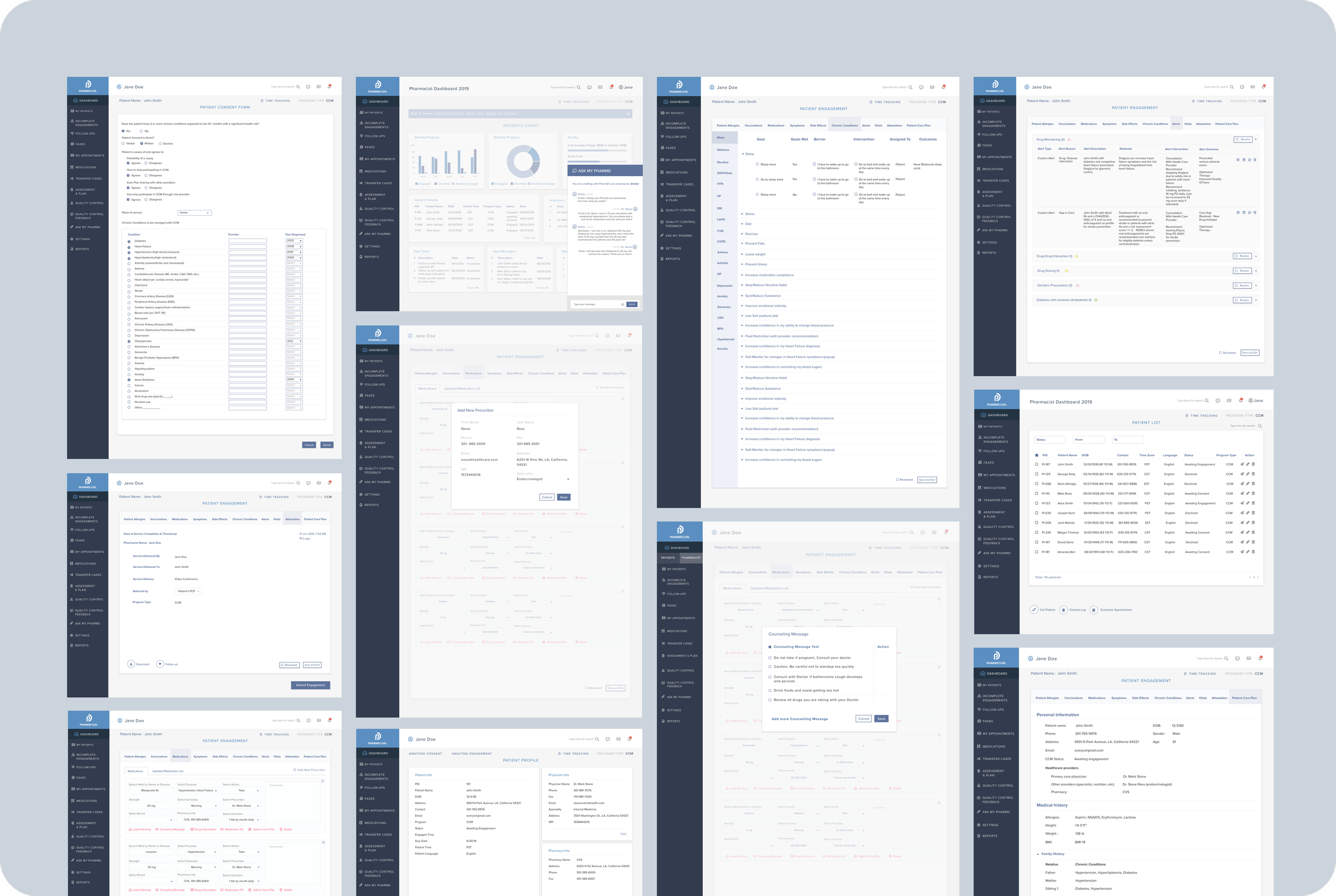
Established the UI direction
Designed a healthcare-friendly visual style:
Clean whites and soft blues/greens
High readability typography
Generous spacing for accessibility
Clear button hierarchy
Front-End Development Contributions
In addition to my core responsibilities as UI/UX Designer, I brought hands-on front-end development experience to the project by translating designs into working code and improving the implementation handoff between design and engineering.
Converted UI screens and interactions into HTML5, CSS3, and JavaScript using the Bootstrap framework, enabling prototyping and early usability testing
Built responsive layouts, collaborated directly with developers to ensure alignment between design intent and functional UI output
Improved efficiency of design-to-development handoffs by pre-validating layout constraints and interaction patterns in code
Leveraged coding experience to troubleshoot UI bugs and recommend performance-friendly UI techniques
This blend of design and front-end implementation strengthened project delivery and helped the team iterate more quickly, with fewer revisions during development.
Support mobile behaviour


Outcome
The redesigned platform provided:
A trustworthy telehealth experience
Higher clarity for medication and consultation information
Improved usability for elderly and non-technical users
A streamlined consultation journey
Consistent UI patterns across modules
The platform became significantly more intuitive and aligned with healthcare UX best practices.

What I Learned
Through this project, I deepened my understanding of:
How to design for sensitive medical data
The importance of clarity and readability
Accessibility requirements in healthcare
Creating calm, reassuring UI patterns
The need for collaboration with pharmacists and clinical stakeholders
Healthcare UX requires empathy — every element must help the user feel supported, safe, and confident.